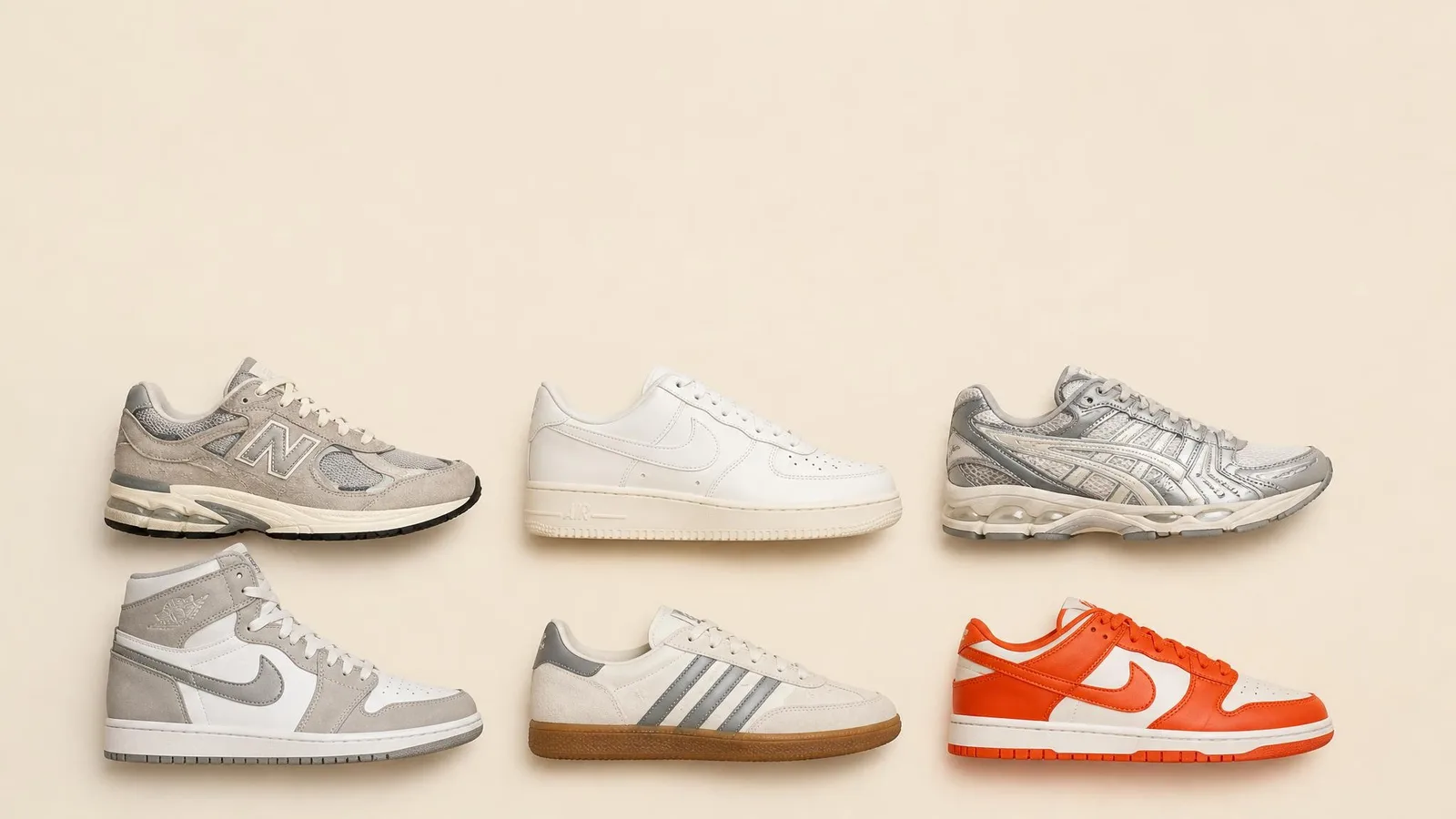
Your sneaker collection does not have one universal value. "Worth" can mean gross market value, replacement cost or net resale proceeds after selling costs. These figures are not interchangeable. A defensible estimate identifies the exact SKU and size, uses a consistent market reference, adjusts for condition and explains any stale or fallback data. Any sneaker resale value calculator worth using produces a directional number built from 5 inputs: exact pair identity, size, condition, recent comparable sales data and timing. CYKI snapshots its market inputs daily, although an individual pair's value may not change every day. It prioritises recorded sales but uses documented asking-price and all-size fallbacks when exact-size sales data is unavailable.
What is your sneaker collection actually worth? A defensible estimate starts with size-specific market data, then applies a clearly disclosed condition adjustment where comparable used-pair sales are unavailable.
Most collectors arrive at an inflated total because they sum the highest listing prices they can find. That number feels precise, but it overstates what the market has actually demonstrated. The 5 variables below are how you calculate sneaker collection value with the gaps explained rather than hidden.
Why Your Collection Is Harder to Value Than a Single Pair
Looking up 1 pair gives you 1 data point. A collection of 30 pairs gives you 30 data points, each with its own size, condition state, market liquidity and recency of comparable sales.
Those 30 pairs rarely share the same market conditions. A just-released colourway has a volatile price spread. An established pair with frequent recent transactions generally provides a stronger signal. Treating both the same way produces an estimate that looks consistent but hides meaningful uncertainty.
Adding up the best price you can find for each pair compounds that problem. It ignores size penalties, condition downgrades, platform fees and the reality that you cannot sell everything simultaneously at peak price. Your estimated rack value, the total CYKI calculates across your collection, needs a consistent methodology applied pair by pair. Not a best-case lookup repeated 30 times.
Five Inputs for Estimating Gross Collection Value
These inputs estimate gross market value before selling costs. To estimate net proceeds, separately account for marketplace fees, seller tier, region, shipping and the discount required to sell within your preferred timeframe.
Every credible approach to estimating how much your sneaker collection is worth accounts for the same 5 variables. Skip any one of them and the total drifts from useful estimate to optimistic guess.
- Pair identity. Exact model name, colourway and SKU. A "Jordan 1 Chicago" spans multiple releases across different years with different price histories. Vague identification produces a vague estimate. Record what to record for each pair in your collection before you start pricing.
- Size. Resale prices for any silhouette vary by size. Resale prices are size-specific because supply and demand vary by SKU. There is no reliable market-wide rule that extreme sizes always sell for less or that sizes 10–11 always command a premium. Use comparable data for the exact size and sizing category: men's, women's, or grade school.
- Condition grade. Dead stock commands the strongest premiums. Even light creasing or midsole yellowing can reduce a pair's comparable sale price relative to an unworn equivalent. Condition is a spectrum, not a binary.
- Recent comparable sales. The price buyers actually paid in completed transactions, not the asking prices sellers are hoping for. Completed sale data from resale marketplaces is the most reliable signal available for what are recent comparable sales for sneakers.
- Timing. Newly released pairs often have wider and less stable price ranges, while established pairs with frequent recent sales generally provide a stronger valuation signal. Assess the number and age of comparable transactions rather than relying on a universal stability period.
Comparable Sales Data: Why Completed Transactions Beat Asking Prices
Completed sales provide evidence of past transactions, while bids and asks describe the current market. Use recent size-specific sales to estimate gross market value, the highest current bid minus selling costs to estimate immediate-sale proceeds, and the lowest ask plus purchasing costs to estimate replacement cost.
Collectors in resale-focused communities consistently prefer actual transaction records over current listings when checking prices. A thread in the r/Sneakers community documented this preference clearly: collectors cited sold listings and completed sales as the most trustworthy price signal, well above whatever a seller had optimistically posted.
Cross-platform comparisons add another layer of complexity. Resale platforms grade condition differently from each other, meaning a pair listed as "very good" on one platform may be graded and priced as "good" on another. That inconsistency is why real resale activity from completed transactions, not live listings, is the foundation of any credible sneaker comparable sales data. You can read more about why different resale platforms show different prices for the same pair.
For a collection-level estimate, every pair needs its own comparable sales lookup at its specific size and condition grade. A single platform's headline price for a model is rarely the right number for your specific pair.
Size, Condition and Timing: The Variables That Move the Number
Does shoe size affect resale value?
Size affects resale price more than most collectors expect. Size can materially affect resale value, but the direction and size of the difference vary by SKU. Compare the exact size and sizing category instead of applying a market-wide premium or discount rule. Assuming the most-cited price applies to your size produces an inflated estimate. Your pair is not the median pair.
Sneaker condition grading and resale price
Condition is the variable most collectors underestimate. Even subtle degradation, light creasing, midsole yellowing, missing original box, aged laces, can reduce a pair's resale value relative to a dead stock equivalent. Condition adjustments are estimates unless they are supported by comparable used-pair sales. CYKI starts with deadstock marketplace data and applies its own conservative condition-grade reductions. Its methodology states openly that these reductions are not derived from measured sales of condition-graded used sneakers. Because condition grading is subjective, small pair-level differences can compound into a material collection-level variance. Treat condition-adjusted values as estimates, not observed sale prices.
Timing and geography
Timing creates volatility at both ends of a pair's life cycle. Newly released pairs have unstable comparable sales spreads as the market finds equilibrium. Pairs that have been on the secondary market for years may have thin recent transaction histories, making any estimate less reliable.
Geography affects what you would actually receive. A silhouette with strong cultural traction in one market may move at a lower price point elsewhere, and platform availability varies by region. Size, condition, timing, geography and platform fees all shape the gap between an estimate and what lands in your account.
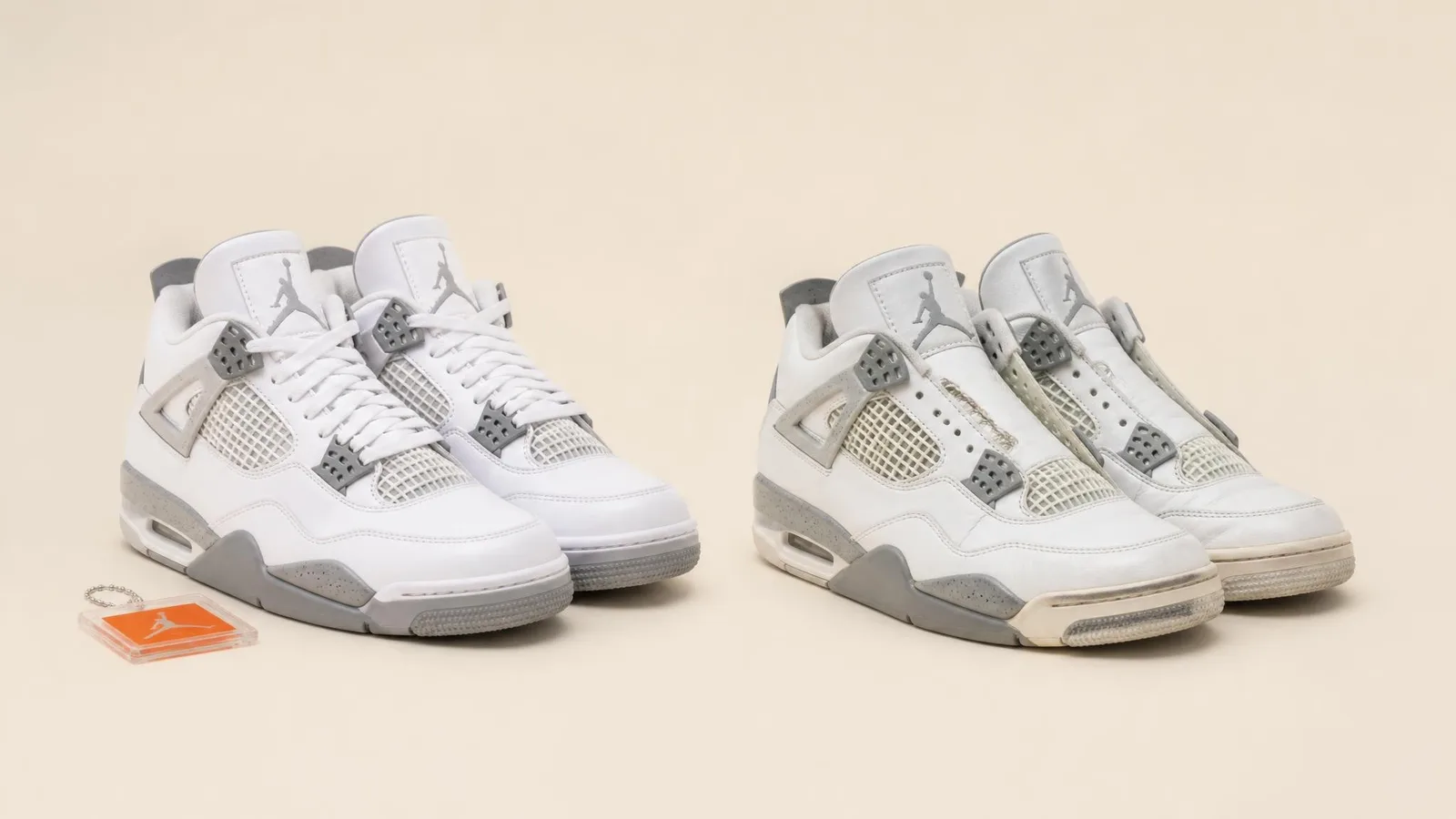
When There Are No Recent Sales: How Limitations Work
Some pairs have no recent comparable sales at all. Obscure collaborations, older releases, very limited regional drops. The absence of data is itself useful information.
CYKI normally uses the median of up to the last five recorded sales in the exact size. If that size-level sales signal is unavailable, it falls back to the current lowest ask for that size and then, if necessary, to the product's overall average across sizes. If the shoe has not sold in any size for 60 days, CYKI displays $0 with a "no recent sales" label rather than averaging stale asks. Papering over a gap with a number that looks authoritative is worse than acknowledging the gap.
Rarity alone does not establish market value. When recent transactions are absent, confidence in any claimed premium falls substantially. If buyers are not transacting, the pair's sneaker value when no recent sales are available is genuinely unknown, regardless of how limited the release was.
CYKI flags data gaps openly rather than hiding them. Your rack value, an estimate based on resale marketplace data, reflects what the market has actually demonstrated, not what you hope a rare pair might fetch. You can see how CYKI's methodology handles data gaps in detail.
Why Summing Listings Gives You a Number, Not a Realistic Sneaker Resale Value Estimate
When you look up each pair at its highest visible listing price, ignore size adjustments, assume dead stock condition and skip the fee calculation, every pair is overvalued. Across 30 pairs, those individual overstatements compound into a total that may be significantly higher than what you would actually receive.
Platform fees make the gap wider. Net proceeds vary by marketplace, seller level, rating, region and selling route. As of 25 August 2026, StockX's Verified Marketplace charges a 3% processing fee plus a 7–9% transaction fee, while eligible Listings Marketplace sellers currently pay no standard selling fee. GOAT's minimum commission for a seller in good standing is 9.5% plus a location-based seller fee. Check the platform's current terms before calculating net proceeds.
The result is a number that looks like a valuation but is actually a best-case fantasy built from asking prices, not buyer behaviour. There is a real difference between understanding the difference between collecting and reselling, and knowing your number is one side of it.
A defensible rack value estimate uses completed sale prices at your specific size and condition grade, accounts for the timing of those sales, and is honest about pairs where data is thin.
Basic collection-value formula
Gross pair estimate = size-specific reference price × condition factor Gross collection estimate = sum of all pair estimates Net resale estimate = gross collection estimate − platform fees − seller-paid shipping − expected selling discount
Keep gross market value and estimated net proceeds as separate outputs. A calculator that combines them without identifying its assumptions can produce a precise-looking but misleading result.
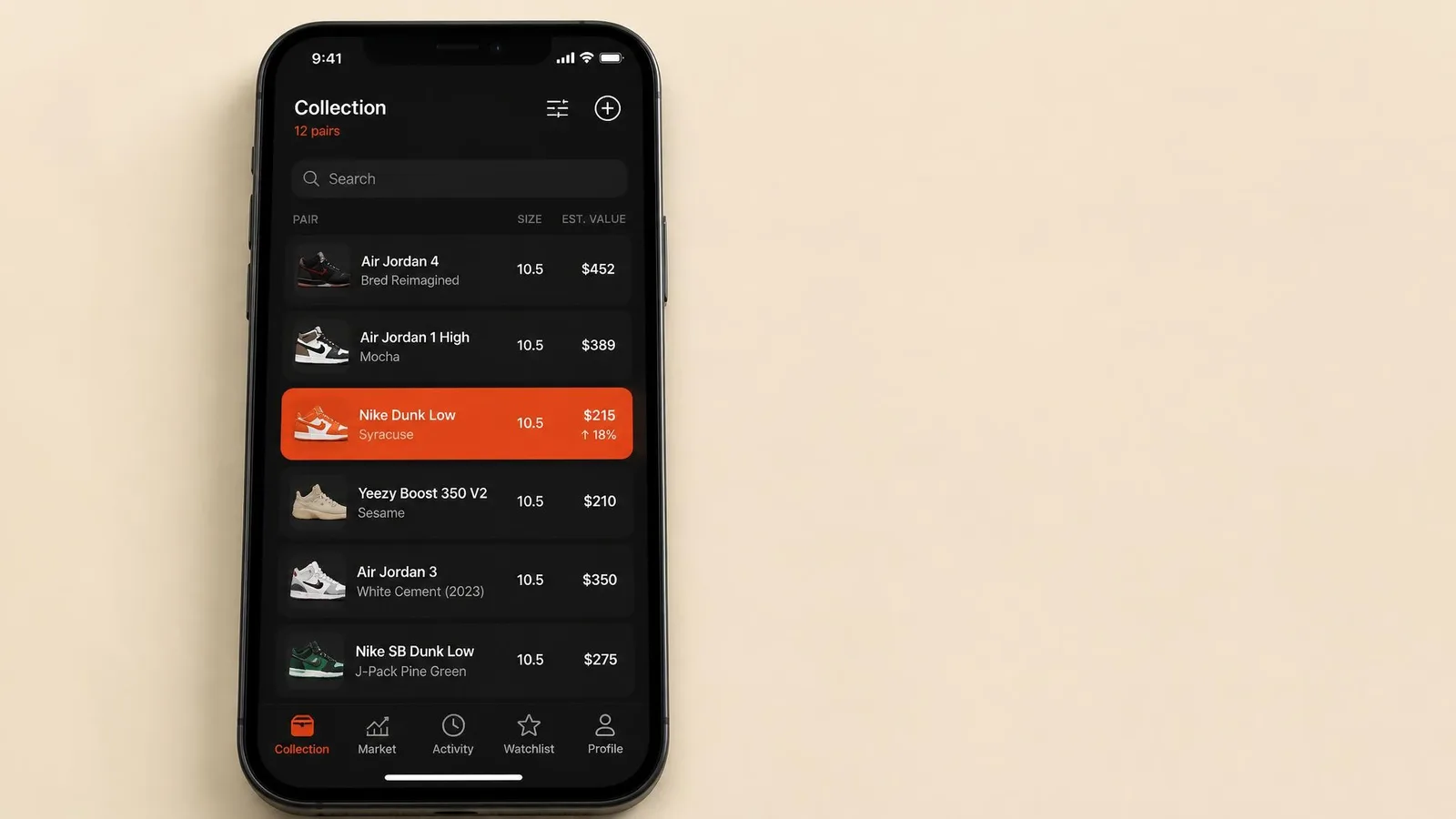
How CYKI Assembles Your Rack Value
CYKI calculates a size-specific reference value using the median of up to five recorded sales, subject to its documented fallbacks. It then applies an internal condition-grade reduction where the user has graded the pair. Market inputs are snapshotted daily, but marketplace data may be incomplete or delayed, and the estimate does not model the final platform, fees or timing of an actual sale.
Every rack value is an estimate based on resale marketplace data. It reflects what comparable pairs have sold for under comparable conditions, not what your pairs are guaranteed to sell for.
Where comparable sales are thin or absent, CYKI flags the gap rather than substituting a guess. The total you see is grounded in what the market has actually demonstrated.
Thinking of your collection as what a sneaker portfolio actually means changes how you track it. Adding pairs is designed to be fast: find the pair, choose your size, rack it. Whether you add pairs manually or use a migration feature later, the pricing and daily updates are handled for you.
Frequently Asked Questions
Why is my sneaker estimate different from the listing price I see on resale platforms? Listing prices reflect what sellers are asking. Estimates built from comparable sales reflect what buyers have actually paid. Those 2 numbers are rarely the same, and the gap is usually in the seller's favour.
How accurate are sneaker resale price estimates? Any estimate built from comparable sales carries inherent variance. Condition interpretation alone can shift a pair's value by a material margin. Treat every estimate as a directional benchmark, not a guaranteed sale price.
What is the difference between a sneaker resale estimate and an actual sale price? An estimate tells you what comparable pairs have sold for under similar conditions. Your actual sale price depends on when you sell, which platform you use, your seller rating, buyer demand on that day and the fees deducted from your proceeds.
What happens if there are no recent sales for one of my pairs? A methodology may mark the pair as unpriced or apply a disclosed fallback. CYKI can use a size-specific ask or an all-size average, but shows $0 when the shoe has recorded no sale in any size for 60 days.
Does shoe size affect resale value? Yes. Sizes at the extremes of a silhouette's demand curve typically trade at a discount to the median. Assuming the most-cited price applies to your size can overstate your pair's estimated value.
Is there an app that tracks my sneaker collection value? CYKI is scheduled to launch free on iOS and Android on 26 August 2026. It lets collectors catalogue supported pairs, record cost basis, view size-specific market estimates and apply condition-grade adjustments. See how CYKI compares with other sneaker collection apps for a detailed breakdown.
Conclusion: Know Your Number, Know Its Limits
A defensible sneaker collection worth estimate is built from 5 consistent inputs applied across every pair, not from the highest listing price available for each model. The number you get from a methodology-first approach will often be lower than a listing-price total. It is a number you can actually stand behind. Compare your rack against the CYKI 100 to see where your collection sits relative to the broader market.
Every rack value is an estimate based on resale marketplace data, not a quote or guaranteed sale price.
Some pairs are personal. Some are valuable. Most are both.
Your collection, known. Rack your pairs on CYKI to see an estimated collection value, as a sneaker collection value tracker built for collectors who want the real number.