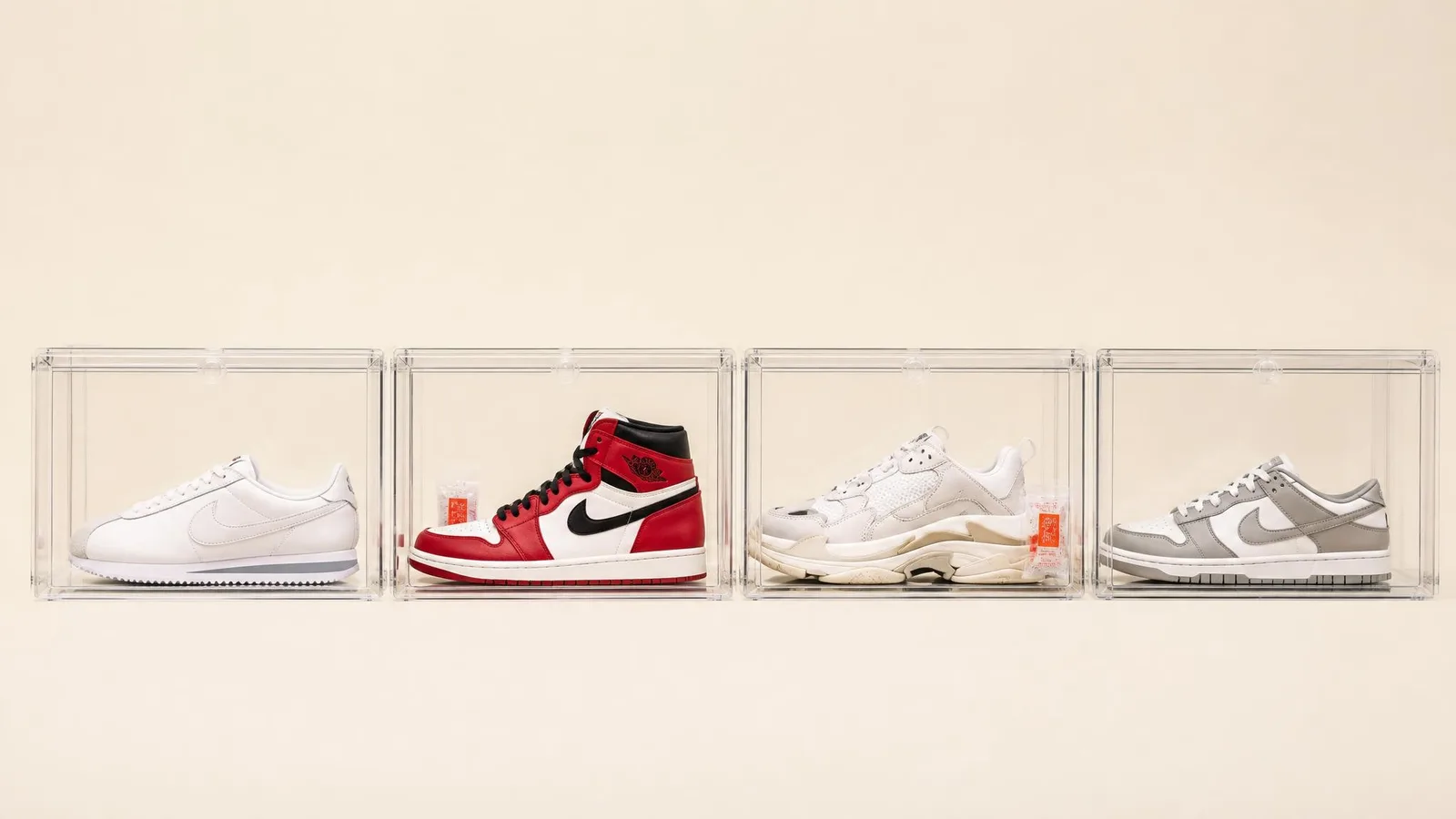
How you store a pair determines its sneaker condition grade, and that grade sets its resale ceiling. Every collector's shelf holds a mix of personal favourites, limited releases, and potentially resellable pairs. A sneaker display case is not a tidiness upgrade. It is a financial decision that protects (or quietly erodes) your collection's worth, one pair at a time.
The best sneaker display case for protecting resale value uses UV-blocking acrylic (OP-3 specification or equivalent), seals tightly enough to maintain silica gel desiccant at 40–50% relative humidity, and sits away from direct sunlight. Standard clear acrylic transmits up to 92% of UV radiation and offers almost no protection for midsole materials.
This guide covers the three environmental threats that degrade sneakers in storage, the real trade-offs between original boxes and display cases, what to look for in a case that actually works, and a tiered storage framework matched to how you use each pair.
Why Storage Is a Resale Decision, Not Just a Display One
On many resale platforms, condition designation is binary. A pair either qualifies as deadstock or it does not. That single classification determines which market tier it enters and what price ceiling is available to the seller. There is no sliding scale. A lightly yellowed midsole or a crushed original box can knock a pair out of the deadstock tier entirely.
The problem is that storage failures cause condition grade drops in pairs that have never been worn. Sole yellowing from UV exposure, adhesive separation from temperature swings, mould from trapped humidity: none of these require you to lace up and walk outside. They happen on the shelf, inside the box, behind the glass.
That percentage matters. If you are holding a pair currently valued at $300 at deadstock, a storage-induced grade drop could mean losing a significant portion of that ceiling before you ever list the pair. Multiply that across 10 or 20 resellable pairs and the gap becomes a real number in your total collection value, individual pair performance, and overall profit or loss.
A collector who tracks what they paid but ignores how their pairs are stored is looking at half the picture.
The Three Environmental Threats to Your Sneakers' Condition Grade
Three forces quietly degrade sneakers in storage. Each one targets specific materials, and each one is preventable once you know what to control.
UV Light and Sole Yellowing
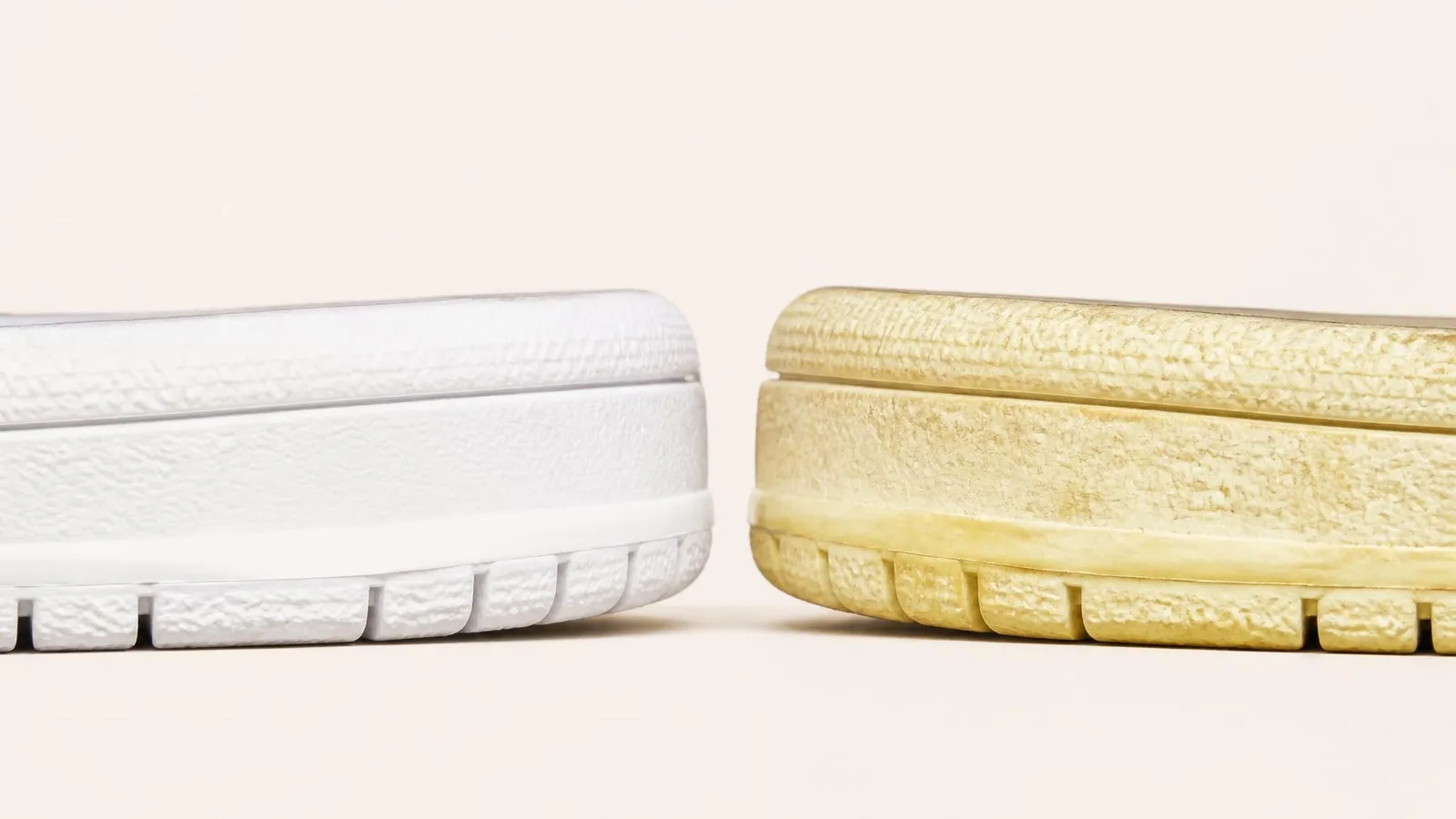
Ultraviolet light accelerates polymer degradation in polyurethane and EVA foam, the two materials used in most sneaker midsoles. This is the primary mechanism behind sole yellowing, and materials science literature published in journals like Polymer Degradation and Stability has documented how UV-induced oxidation breaks down these polymers over time. The process is slow enough to be invisible week to week, but the cumulative effect turns a white midsole cream and eventually brown.
Here is the misconception most collectors miss: standard clear acrylic transmits up to 92% of UV radiation. A display case near a window, unless it uses UV-blocking acrylic (look for an OP-3 specification or equivalent UV transmittance rating), offers your midsoles almost no protection. The case looks protective. It is not.
Humidity and Material Damage
Relative humidity above 60% creates the conditions for mould growth on leather, suede, and textile uppers. Humidity below 30% does the opposite kind of damage, accelerating cracking of natural leather and drying out the cement adhesives used in sole bonding. Conservation literature on footwear preservation, including guidance from institutions like the Victoria and Albert Museum, identifies the 40–50% RH range as the target for long-term preservation of leather and bonded-sole footwear.
The practical question is whether your storage space falls in the danger zone. A cheap hygrometer (under $15) gives you the answer in minutes. If humidity runs high, silica gel desiccant packets inside a sealed case or container bring it into range. Those packets have a finite absorption capacity, though. They saturate over time and need to be refreshed or replaced every 6–12 months, a detail that Conservation Resources International flags in its technical documentation for silica gel products. One-and-done does not work.
Temperature Fluctuations and Sole Separation
Consistent heat or cold is less dangerous than the cycling between them. Repeated temperature swings stress the adhesive bonds in vulcanised and cupsole constructions. Does temperature damage sneaker soles? Yes, but the mechanism is fatigue from expansion and contraction, not melting. Adhesive chemistry literature on thermal cycling fatigue confirms that repeated cold-to-warm transitions weaken the glue joints that hold soles to uppers.
Garages, attics, and any space with seasonal temperature swings are the worst storage locations for pairs you care about. A climate-controlled room at consistent temperature is the single simplest environmental protection you can provide.
Original Box vs. Sneaker Display Case: What Collectors Actually Need to Know
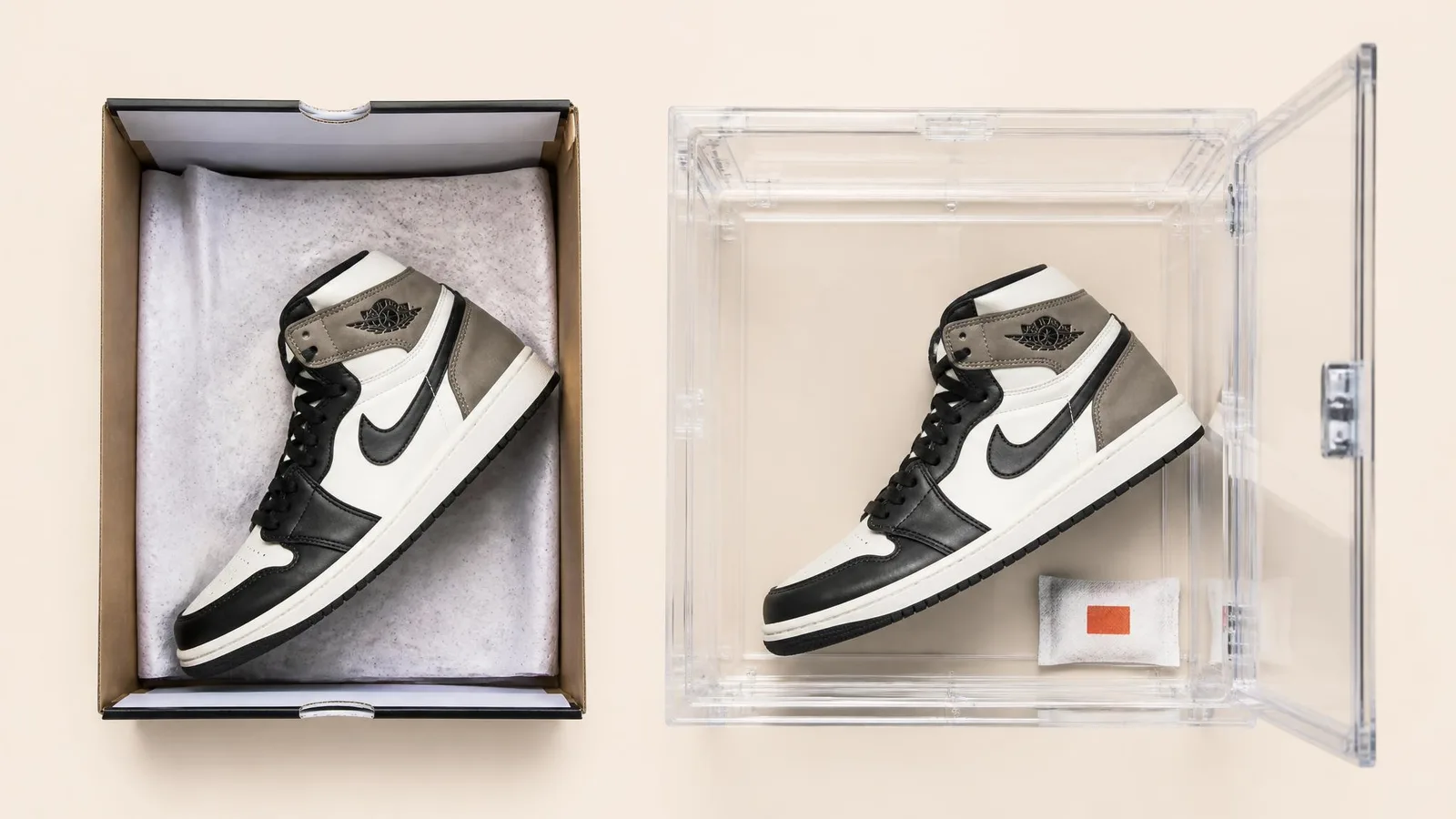
The original box is not always the safest option. It is also not always the wrong one. The right format depends on what you intend to do with the pair: holding, wearing, buying, or selling.
| Factor | Original Box | Display Case (UV-Blocking, Sealed) |
|---|---|---|
| UV Protection | Full light block (opaque) | Depends on acrylic spec. UV-blocking acrylic protects; standard acrylic does not |
| Humidity Control | None. Cardboard can trap moisture | High, when paired with silica gel desiccant |
| Airflow | Restricted. Can accelerate yellowing in humid environments | Controlled. Sealed cases maintain desiccant-regulated RH |
| Condition Monitoring | Impossible without opening | Visible at a glance. Easier to spot yellowing or mould early |
| Box Condition as Grading Factor | Preserved by default (box stores itself) | Box stored separately; risk of damage if not handled carefully |
| Dust and Physical Protection | Good | Excellent |
| Cost | Free (included with purchase) | Moderate to high depending on spec |
Original boxes work well for pairs you wear regularly or store in dark, temperature-stable environments where humidity stays in the 40–50% range naturally. The box blocks light completely, protects against dust, and preserves the unboxed presentation that some resale buyers expect.
Display cases are the better choice for limited releases, resellable grails, or any pair stored in a room with natural light. A sealed case with UV-blocking acrylic and desiccant gives you humidity control, light protection, and visible condition monitoring. You can spot the first signs of yellowing or mould without ever opening the case.
Original cardboard boxes can trap humidity in poorly ventilated spaces and restrict the airflow that prevents moisture from settling on materials. A pair stored in its box inside a humid closet may quietly develop mould before you ever check on it.
How to Choose a Sneaker Display Case That Actually Protects Your Pairs
Not every display case protects your pairs. Most are sold on aesthetics, stackability, and price. The four specifications below are what actually determine whether a case preserves or degrades the sneakers inside it.
-
UV specification. Confirm whether the acrylic is UV-blocking. Look for an OP-3 specification or a UV transmittance rating from the manufacturer. If the listing does not mention UV protection at all, assume the case transmits UV. Most cases sold on mass-market retailers do not specify this, which tells you something. A sneaker display case for your sneaker collection storage setup needs to start here.
-
Seal quality and humidity control. A fully sealed case without desiccant traps whatever moisture is already inside. A case with ventilation gaps loses any humidity regulation you try to maintain. The best humidity level for storing sneakers is 40–50% RH, and the case needs to seal tightly enough to hold desiccant-regulated air while still allowing you to open it periodically for silica gel refresh.
-
Structural support. Heavier silhouettes (chunky trainers, high-top basketball shoes) need a case with a rigid base that distributes weight evenly. A flexible base allows the midsole to compress against a surface edge over time, creating pressure marks that affect both appearance and condition grade.
-
Door mechanism vs. seal integrity. Magnetic door and drop-front designs are convenient for pairs on your daily rotation. But seal quality varies significantly across designs. For any pair you are holding long-term, prioritise how tightly the case closes over how easily it opens. Your rack looks better when the cases are uniform, but function comes first for pairs with resale value on the line.
If a case does not specify its acrylic UV protection, do not assume it has any.
A Storage Strategy for Every Tier of Your Collection
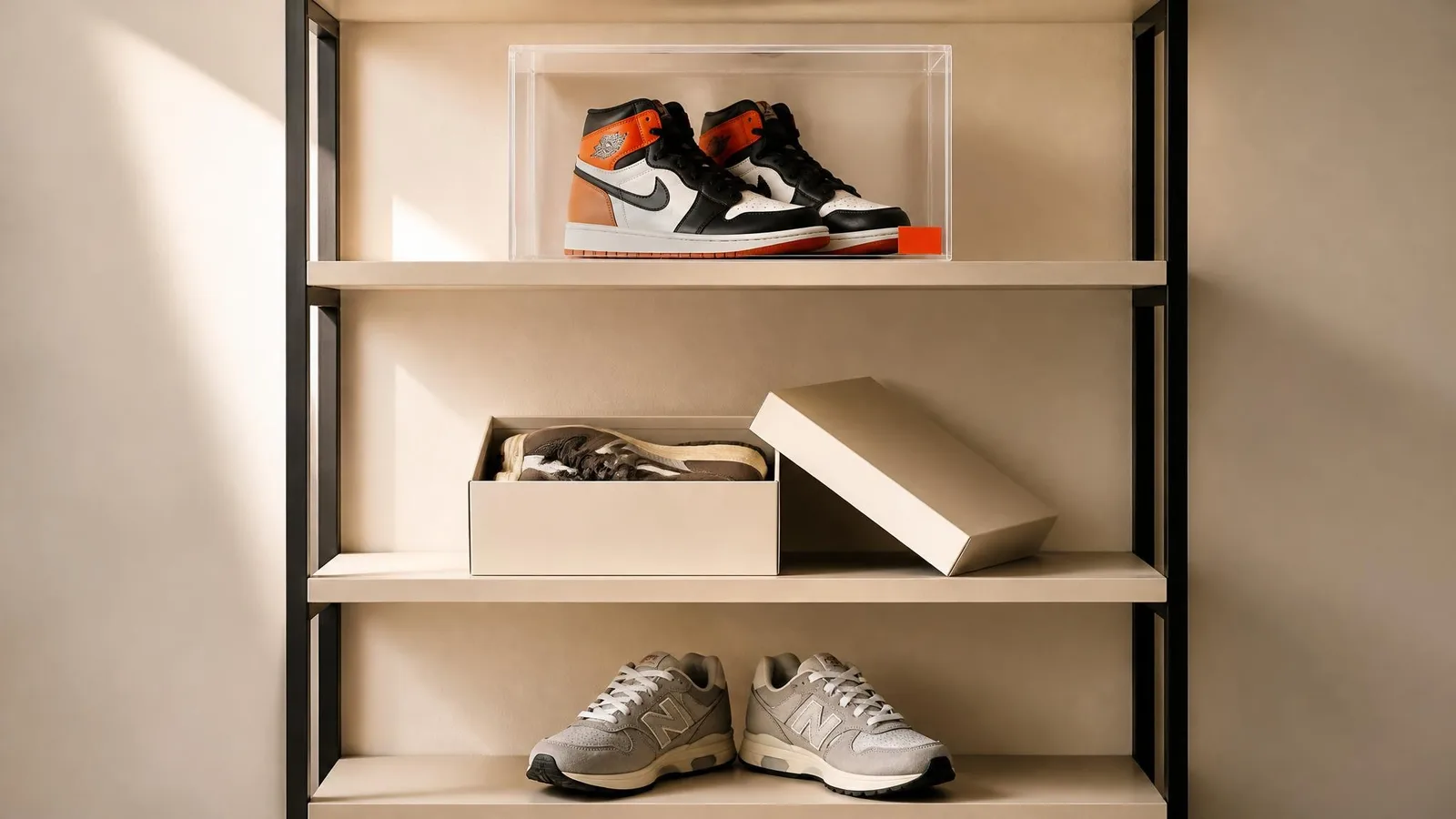
Your collection is not one thing. It is a mix of personal favourites, limited releases, and potentially resellable pairs. A blanket storage approach wastes money on some pairs and under-protects others. Match the storage to the tier.
-
Daily wearers. Original box or open shelf storage. These pairs are already taking wear exposure. The priority is accessibility and basic dust protection, not long-term preservation. Spending on UV-blocking cases for your rotation is unnecessary. Keep them clean, keep them accessible, keep it simple.
-
Limited releases held for personal reasons. Display case with standard maintenance: silica gel refreshed every 6–12 months, positioned away from direct light. These pairs benefit from visible condition monitoring and light protection even if resale is not the primary intent. You want to see them. You also want them to stay clean.
-
Resellable grails and deadstock pairs. UV-blocking acrylic display case in a temperature-stable room, desiccant-maintained at 40–50% RH, never near a window. These pairs have a measurable resale ceiling, and sneaker storage for resale means treating that ceiling as something worth protecting. Every environmental variable covered in this article applies most urgently here.
Most collectors hold all three tiers at the same time. The point is not to over-engineer every pair. It is to put the strongest protection where the financial and personal stakes are highest.
Know What Your Collection Is Worth Before and After Storage
Physical storage preserves condition. Digital cataloguing makes that condition legible as portfolio value. You can store every pair perfectly and still not be able to answer the question: what is my collection worth today?
That is the gap CYKI closes. Log each pair with its purchase price and size, and CYKI surfaces current resale value updated daily so you can see individual pair performance and overall portfolio movement. No more scattered spreadsheets, notes, screenshots, or marketplace watchlists. One rack. Kept current.
The collector who invests in proper sneaker collection storage and a quality sneaker display case for collectors is exactly the collector CYKI was built for. You already care about what your pairs are worth. CYKI shows you.
Track every pair in your collection and see what your collection is actually worth right now. You can read more about how CYKI calculates resale value to understand the data behind every number. If you are evaluating which tools to use alongside your storage setup, see how best sneaker app collectors compared to find the right fit for your collection.